


Original contemporary creations by Phi-Artiste
As a Phi-Artist-Painter, I devote myself to portraiture, landscape painting and still life using oil paints, a technique that allows me to work on minute details and create light and texture effects with exceptional precision and realism.
I seek to capture the essence of reality, not to freeze it, but to make it vibrate. This realistic approach is not a quest for photographic perfection; each brushstroke, each irregular glaze, each shadow that stretches with a slight hesitation betrays the hand that drew it. My works remain faithful to the medium of oil: thick, rebellious, always alive. My paintings invite you to come closer, to scrutinise the traces of the human hand in the details. It is there, in the medium and the gesture, that I leave my mark, in a silent dialogue between the subject and the artist who painted it.
Summer Dream Collection

Where The Sky Rests is a studio exercise: a large-scale oil copy (95 × 149 cm), freely inspired by a particularly accomplished photograph by “alfone45.” The distinction is deliberate. This is not presented as an autonomous creation, but as a work of translation — a dialogue between photographic image and oil painting. Few photographers succeed in capturing legendary automobiles with real dignity, mastering reflections, light, and perspective without flattening their complexity.

On the Way Back Home, painted recently, continues the exploration of the automobile motif, no longer through the brilliance of the bodywork, but from within the cabin — as a space of sensation, withdrawal and suspended perception. The work questions the car interior as an in-between place: neither fully refuge nor fully exposure. The body finds a temporary shelter there, yet remains bound to a machine moving through the flow, heading toward the unknown. As evening falls, the figure curled inside

‘Golden Whisper’ is, of course, the Porsche 911, a marvel of the automotive industry. Launched at the Frankfurt Motor Show in September 1963, the Porsche 911 quickly became an icon of automotive design. The perspective chosen here emphasises the headlights, which earned it the nickname ‘Frog’ from its owners. The oil technique, with its flexible glazes and deep pigments, captures the variations in light and prolongs the reflections. Here, it recreates the brilliance of the yellow bodywork.
Where The Sky Rests is a studio exercise: a large-scale oil copy (95 × 149 cm), freely inspired by a particularly accomplished photograph by “alfone45.” The distinction is deliberate. This is not presented as an autonomous creation, but as a work of translation — a dialogue between photographic image and oil painting. Few photographers succeed in capturing legendary automobiles with real dignity, mastering reflections, light, and perspective without flattening their complexity.
The Summer Dream series pays tribute to European automobile manufacturers and to the metalworkers whose technical mastery shaped some of the most refined machines of the twentieth century. It celebrates precision: the line, the curve, the play of reflections, the intelligence of engineering, and the exceptional aesthetic discipline embedded in industrial art.
The series mainly consists of what I deliberately call “studio exercises.” These paintings are meticulous transpositions of particularly successful photographs — either personal or borrowed — of historic sports cars, including Lamborghini models such as the Miura, Countach, Huracán and Centenario. Such images are rare. Few photographs truly capture the structural elegance, surface tension and complex reflections carried by these polished bodies.
Here, copying is not a reductive form of imitation. It belongs to a long historical tradition in painting: a method of analysis, translation and technical investigation of the chosen image. It becomes a strategy — a renewed engagement with matter, framing and light. Through the medium of oil paint, the photographic instant is slowed down, dissected and reconstructed: metallic surfaces are reinterpreted through successive glazes, depth is rebuilt through layering, and light is recalibrated through controlled tonal transitions.
What is “copied” is not merely a motif, but a visual grammar. The distinction between creation and studio exercise is therefore explicit: the former invents the image; the latter interrogates it. Yet both share the same commitment to precision, material intelligence and the slow temporality proper to oil painting.
"Origins" Collection 2025
The "Origins series highlights the minimal and fundamental relationship that binds humankind to Nature, as well as the painter’s attempt to make perceptible what comes before, what exceeds us, and what remains — within the simplicity of a material held in tension and of the gaze that lingers upon it. The human figure stands at the center of these dynamics: capable of articulating beauty where the original matrix remains silent. It is an instance of the world’s exhalations, an assemblage subject to the same elemental cycles and the same forces — variations, constraints, collapses, recompositions: a chaos distilled to the scale of the living.”

Volchaos observes the Earth’s fire in its natural progression, driven by matter in motion, carried by oil that ignites, expands, consumes itself, and then disappears into the depths of the primordial rock. The shift from water to fire is not a rupture but a displacement, centered on matter in action—on a force that transforms and exhausts itself, only to rise again. The elements embody the continuity of the real world, the constancy of the processes that traverse it.

“Fresh Helicoidal Flux” is the first work of a triptych entitled Water Chaos, part of a broader reflection on the idea of “being born into the world.” What does it mean to be born into the world? To emerge involuntarily in a specific place, within a so-called “universal” environment—one that contemporary society no longer fully perceives, having domesticated it to the point of concealing its underlying chaos.
Volchaos observes the Earth’s fire in its natural progression, driven by matter in motion, carried by oil that ignites, expands, consumes itself, and then disappears into the depths of the primordial rock. The shift from water to fire is not a rupture but a displacement, centered on matter in action—on a force that transforms and exhausts itself, only to rise again. The elements embody the continuity of the real world, the constancy of the processes that traverse it.
Portraits: eternity before us
What distinguishes my work as a portrait painter is the combination of a saturated chromatic palette, carefully constructed framing, and particular attention to emotional nuance. In my portraits of children and adults, color becomes a way to stage and illuminate emotion. I also seek to capture moments of intimacy that may seem insignificant at first glance: a game, a walk, a moment of drowsiness… the simple gestures of everyday life in the twenty-first century, so different from the twentieth century we have lived through. These details reveal our ways of living, our disarray, and our obsessions: painting sheds light on the rituals through which we try to shield ourselves from the world, as well as on our desire to invest in it, transform it, and conquer it. Through these scenes, sometimes touched with a hint of humor or irony, I explore the shifting tensions between human beings — always ready to find the most just and comfortable place in which to exist — and the environment that surrounds them.
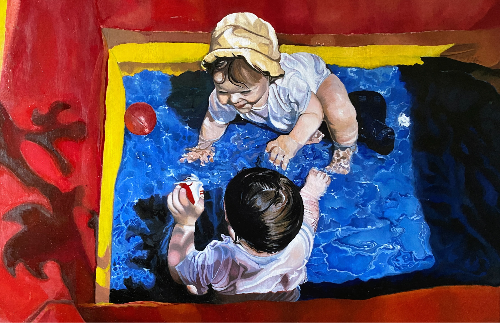
Children's water games. A theme that confronts the painter with a work on water, water that slides, water that moves or stagnates, water in oil and oil in water. Water through which images are distorted, water that also sticks T-shirts to the skin. Effects of transparency, colours, wetness, play of light and shadow. A difficult exercise for the painter.

One summer morning in the South. It is very early, and sunlight floods the kitchen. The child is already there, his face dazzled by the bright light. Leaning on the bar, grimacing. The raspberry ice cream does not ease the pain; it runs down his red throat. The aroma and the sugar distract him a little. He has just had an operation. He is in pain, a lot of pain. As an artist, this moment and this light appeal to me. A palette of yellows, pinks and ochres. The crimson red of his lips.

Painting a baby... what an idea. When I did it, it seemed strange to me, probably because I don't remember seeing many in museums. Babies are not a subject. Interesting! But why is that? Their expressions and postures are varied, explicit, sometimes extreme. In fact, I found it difficult to convey his emotions here. Is he laughing or crying? The answer is in the title. He is definitely a laughing, mocking and playful baby.
Children's water games. A theme that confronts the painter with a work on water, water that slides, water that moves or stagnates, water in oil and oil in water. Water through which images are distorted, water that also sticks T-shirts to the skin. Effects of transparency, colours, wetness, play of light and shadow. A difficult exercise for the painter.
Dreamlike landscapes
I maintain a constant attention to the forms and rhythms of nature. Water, in particular, draws me in for its ability to merge transparency with depth, to capture light while distorting it. Reflections, shifting shadows, and the slightest surface variations become motifs I explore for their visual strength and their power of abstraction. From this attentive observation emerge landscapes in which the real subtly transforms, drifting toward the dreamlike. Natural elements retain their presence, yet recombine through internal movements, tensions, reframings, or unexpected points of view. I aim less to depict a place than to capture a sensation — that of a world in vibration.

‘Ballet de squilles’ is a peaceful underwater vision, juxtaposing two contrasting scenes: the stillness of the undulating seabed, whose clear waters reveal strange, almost lunar landscapes in the distance; and the brief moment of life and agitation, suggested by an unlikely ballet of multicoloured arthropods, otherwise known as mantis shrimp, small predators in search of microscopic sustenance, in the middle of the sand.

54 x 74 cm Blue does not call for commentary, and its title is of little importance. Blue is just a moment in time, a net of undulating dreams, a musical score. Blue is intoxication, abandonment and torment.

‘Ballet de squilles’ is a peaceful underwater vision, juxtaposing two contrasting scenes: the stillness of the undulating seabed, whose clear waters reveal strange, almost lunar landscapes in the distance; and the brief moment of life and agitation, suggested by an unlikely ballet of multicoloured arthropods, otherwise known as mantis shrimp, small predators in search of microscopic sustenance, in the middle of the sand.
Cinematic Fragments
Cinematic Fragments is a collection of paintings born from an intimate relationship with cinema. Drawing on films from the 1970s to the 1990s, as well as more recent original productions, I extract scenes, shots, and atmospheres that I translate into paint. Removed from their original narratives, these images become autonomous fragments, suspended in time.
They capture moments when the language of cinema resonates with that of oil painting: charged atmospheres, sometimes off-centre framing, tensions between light and darkness, and lines that structure space while shifting the composition. These elements allow the cinematic image to gradually move towards a fully pictorial experience.

In Breaking Bad, Skyler White’s fate is that of a woman gradually trapped within the story constructed by her criminal husband. She did not choose to enter the world of drug trafficking, nor did she invite the violence that invades her home. Ways out exist, but none comes without consequences. Nor is she merely a passive victim: she learns how to launder money, construct convincing lies and manage the criminal enterprise with chilling efficiency.

In this same series, where the fearsome Heisenberg holds sway, the figure of Pinkman commands particular attention. Tossed about by the hazards, mistakes, and miseries of his journey, moving from party-going adolescent clinging to his meth pipe to baritone-voiced drug dealer, he becomes one of the most interesting and complex characters in this jewel of modern screen art. He constantly oscillates between anger and despair, violence and compassion, swaggering stupidity and painful lucidity
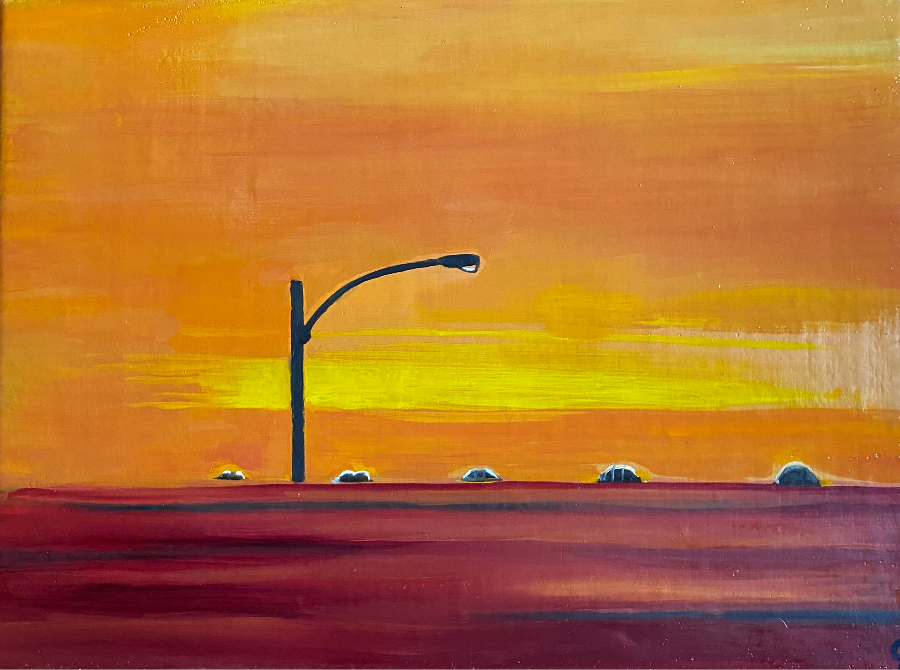
We are at a turning point in the famous film. After a series of fragmented and unsettling appearances, the threat posed by the “Greys” is finally brought into the open. Until now concealed in the shadows, they emerge into the full light of the rising sun. They are coming.
In Breaking Bad, Skyler White’s fate is that of a woman gradually trapped within the story constructed by her criminal husband. She did not choose to enter the world of drug trafficking, nor did she invite the violence that invades her home. Ways out exist, but none comes without consequences. Nor is she merely a passive victim: she learns how to launder money, construct convincing lies and manage the criminal enterprise with chilling efficiency.
Animal portraits
Animal portraits extend my attention to the place of the Living, to what in nature remains both fragile and sovereign. I look for the silent presence of these beings, for their brief yet essential expressions that carry something of Nature in its most direct, unadorned form. They offer the artist the opportunity to paint details of great delicacy — feathers, fur, textures — and of captivating beauty.

In this painting, I wanted to highlight a portrait of a bird, a rather strange creature otherwise known as the ‘Grand Ibijau’ in French - ‘The Great Potoo’ in English. While painting it, it reminded me of Blake Edwards' cult comedy starring Peter Sellers, The Party, particularly the episode with the parrot, set against a backdrop of retro aesthetics and jazzy music evoking a disconcerting world and society.

I am Thorlak, God of Oases. I am not just any dog, at least not one who spends his time escaping from his garden and dreaming of the unlikely scent of game. I am quite the opposite. I am the dog who enters houses by any means necessary, because I need to expand my territory and humans distract me. Here, my master has painted me in my kitchen. I am sitting there, very attentive, sly to say the least, in case I can snatch some food.

In this painting, I wanted to highlight a portrait of a bird, a rather strange creature otherwise known as the ‘Grand Ibijau’ in French - ‘The Great Potoo’ in English. While painting it, it reminded me of Blake Edwards' cult comedy starring Peter Sellers, The Party, particularly the episode with the parrot, set against a backdrop of retro aesthetics and jazzy music evoking a disconcerting world and society.